
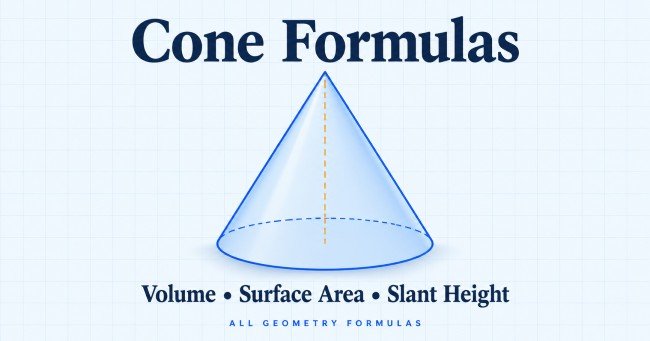
The main cone formulas are volume V = ⅓πr2h, curved surface area CSA = πrℓ and total surface area SA = πr2 + πrℓ. Here, r is the base radius, h is the vertical height and ℓ is the slant height. Do not swap h and ℓ.
This guide covers a right circular cone. Its apex sits directly above the centre of its circular base. The vertical height meets the base at 90°, while the slant height follows the side from the apex to the rim. Worked examples below show which measurement belongs in each formula.
Cone formulas at a glance
| What to find | Formula | Measurements needed |
|---|---|---|
| Volume | V = ⅓πr2h | Radius and vertical height |
| Curved or lateral surface area | CSA = πrℓ | Radius and slant height |
| Total surface area | SA = πr2 + πrℓ = πr(r + ℓ) | One circular base plus the curved side |
| Base area | B = πr2 | Radius |
| Slant height | ℓ = √(r2 + h2) | Radius and vertical height |
| Vertical height from slant height | h = √(ℓ2 − r2) | Slant height and radius |
| Height from volume | h = 3V/(πr2) | Volume and radius |
| Radius from volume | r = √[3V/(πh)] | Volume and vertical height |
| Slant height from curved area | ℓ = CSA/(πr) | Curved area and radius |
| Volume using diameter | V = πd2h/12 | Diameter d and vertical height |
Symbols: V = volume, CSA = curved surface area, SA = total surface area, r = radius, d = diameter, h = vertical height and ℓ = slant height. LSA is another name for curved surface area; some books use TSA for total surface area.
Read radius, height and slant height
Radius is half the diameter: r = d/2. Vertical height measures the perpendicular distance from the apex to the base plane. Slant height is the distance down the side. For a non-flat right cone with positive radius, the slant height is longer than the vertical height.
The three lengths form a right triangle. Pythagoras gives ℓ2 = r2 + h2. Use the positive square root when recovering a length. If a supposed slant height is no greater than the radius, those measurements cannot describe a right cone with positive height.
Volume of a cone
A cone’s volume is one-third of its base area multiplied by its vertical height: V = ⅓Bh = ⅓πr2h. Volume uses cubic units such as cm3 or m3.
A cone has exactly one-third the volume of a cylinder with the same base radius and perpendicular height. That comparison requires both measurements to match. It does not mean every cone is one-third of every cylinder.
Example 1: calculate volume
A right cone has radius 3 cm and vertical height 4 cm. Therefore, V = ⅓ × π × 32 × 4 = 12π cm3 ≈ 37.70 cm3. The matching cylinder would have volume 36π cm3.
Curved and total surface area
Curved surface area measures the sloping side only: CSA = πrℓ. It excludes the circular base. Surface area uses square units, rather than cubic units.
For total surface area, add one base: SA = πrℓ + πr2 = πr(ℓ + r). An ideal conical sheet or hat with no circular end face uses the curved area only. A closed cone includes the base.
Example 2: find slant height and both areas
Use the same radius of 3 cm and height of 4 cm. First calculate the slant height: ℓ = √(32 + 42) = 5 cm. Then choose the surfaces required:
- Curved area: CSA = π × 3 × 5 = 15π cm2 ≈ 47.12 cm2.
- Base area: B = π × 32 = 9π cm2.
- Total area: SA = 15π + 9π = 24π cm2 ≈ 75.40 cm2.
Using 4 cm in the curved area formula would be a mistake. Four centimetres is the vertical height; the sloping side measures 5 cm.
When slant height is given instead
To calculate volume from slant height, first recover the vertical height with h = √(ℓ2 − r2). The subtraction matters: the slant height is the hypotenuse.
Example 3: recover the vertical height
A cone has radius 5 cm and slant height 13 cm. Its vertical height is h = √(169 − 25) = 12 cm. Its volume is V = ⅓ × π × 25 × 12 = 100π cm3 ≈ 314.16 cm3. Its curved area is 65π cm2, and total area is 90π cm2.
Use a diameter correctly
If diameter d is given, halve it to obtain radius. Substituting r = d/2 into the volume formula gives V = πd2h/12. The denominator combines the one-third factor with the division by four from squaring d/2.
Example 4: calculate volume from diameter
A cone has diameter 14 cm and vertical height 9 cm. Its radius is 7 cm, giving V = ⅓ × π × 72 × 9 = 147π cm3 ≈ 461.81 cm3.
Find a missing height or radius
Rearrange the volume formula to match the unknown. Multiply volume by three before dividing. To recover radius, take a square root after dividing by πh.
Example 5: find height from volume
The volume is 48π cm3 and the radius is 4 cm. Therefore, h = 3 × 48π/(π × 42) = 144/16 = 9 cm. This is vertical height, not slant height.
Example 6: find radius from volume
The volume is 108π cm3 and the vertical height is 9 cm. Then r2 = 3 × 10⁸π/(9π) = 36, so r = 6 cm. The diameter would be 12 cm.
If curved area and radius are known instead, use ℓ = CSA/(πr). For example, CSA = 65π cm2 and r = 5 cm give ℓ = 13 cm.
The cone’s net is a circular sector
When the curved side is unrolled, it forms a circular sector with radius ℓ. Its arc length equals the base circumference, 2πr. The sector’s fraction of a full circle is r/ℓ, so its angle in degrees is θ = 360° × r/ℓ.
For r = 3 cm and ℓ = 5 cm, the sector angle is 216°. Its area is (216/360) × π × 52 = 15π cm2, agreeing with πrℓ. Add a separate base circle if making a closed cone.
Units and rounding
Use the same length unit for radius, vertical height and slant height. Convert before substituting. Keep π and square roots in exact form during calculations, then round the final answer. Use a supplied value for π if the question requires it.
Area uses square units and volume uses cubic units. For capacity, 1 litre equals 1,000 cm3. Use internal dimensions when calculating how much a conical container holds.
Common mistakes to avoid
- Using slant height in the volume formula instead of vertical height.
- Using vertical height in πrℓ when curved area is required.
- Forgetting the factor of one-third in volume.
- Using diameter as radius or adding two circular bases.
- Rounding the slant height too early and carrying that error into surface area.
Try these practice questions
- A cone has radius 4 cm and vertical height 3 cm. Find its slant height, volume, curved area and total surface area.
- A cone has diameter 12 cm and vertical height 10 cm. Find its volume.
- The volume is 75π cm3 and the vertical height is 9 cm. Find the radius.
Answers: 1) ℓ = 5 cm, V = 16π cm3, CSA = 20π cm2 and SA = 36π cm2. 2) V = 120π cm3. 3) r = √[225π/(9π)] = 5 cm.
Frequently asked questions
Which height goes in the volume formula?
Use the perpendicular height h from the apex to the base plane. For a right cone, this line ends at the centre of the base.
Does πrℓ include the base?
No. It gives only curved surface area. Add πr2 to include the circular base.
Can diameter replace radius directly?
No. Either use r = d/2 first or use V = πd2h/12. Putting diameter into a formula written for radius gives the wrong result.
Is slant height always greater than vertical height?
For a right circular cone with positive radius and height, yes. Its square equals h2 + r2, so it exceeds h.
Do these surface formulas apply to an oblique cone?
Not generally. An oblique cone does not have one uniform slant height around its rim. Volume is still one-third base area × perpendicular height, but the simple curved area formula here assumes a right cone.
Compare with the cylinder formulas for the same base and height. See the circle formulas for base area, or browse all 3D Formulas guides.
Reference texts: OpenStax, Prealgebra 2e, section 9.6, and Calculus Volume 2, section 2.4; Wolfram MathWorld, Cone and Slant Height. Numerical examples and practice questions were written for this guide.
