
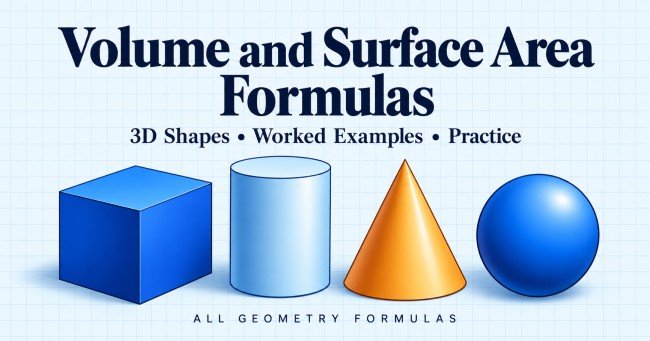
Volume measures the space inside a three-dimensional shape. Surface area measures the total area of its outside surfaces. For a rectangular prism, volume is V = lwh and total surface area is SA = 2(lw + lh + wh). The correct formula depends on the solid and which surfaces are included.
Think of a box: the space available for contents relates to volume, while the material covering its faces relates to surface area. Volume uses cubic units, such as cm³ or m³. Surface area uses square units, such as cm² or m². A practical container’s capacity depends on its internal dimensions.
Volume and surface area formula table
| Solid | Volume V | Total surface area SA |
|---|---|---|
| Cube | s³ | 6s² |
| Rectangular prism / cuboid | lwh | 2(lw + lh + wh) |
| Right circular cylinder | πr²h | 2πr² + 2πrh |
| Right circular cone | ⅓πr²h | πr² + πrℓ |
| Sphere | ⁴⁄₃πr³ | 4πr² |
Symbols: s = cube edge; l = prism length; w = width; h = perpendicular height; r = radius; ℓ = cone slant height. For a right circular cone, ℓ = √(r² + h²). The cylinder formula includes both circular ends, and the cone formula includes its circular base.
These are formulas for ideal geometric solids. If a shape has an opening or a face hidden inside a joined solid, adjust the surface area to match the exposed surfaces. For flat shapes, use the area and perimeter formulas instead.
How to choose the correct formula
- Identify the solid and label its dimensions. Halve a diameter to get a radius.
- Decide whether the question asks for volume, total surface area or only a curved surface.
- Convert all lengths to the same unit before calculating.
- Substitute the measurements, keeping π exact where possible. Round only the final answer and include units.
For a right prism, V = Bh, where B is the area of the base and h is the perpendicular height between the bases. A cylinder follows the same idea with B = πr². A cone has one-third of the volume of a cylinder with the same base radius and height.
Worked examples
1. Cube: all edges equal
A cube has an edge length of 4 cm. Find its volume and total surface area.
Volume: V = 4³ = 64 cm³.
Surface area: SA = 6 × 4² = 6 × 16 = 96 cm².
Each square face has area 16 cm², and there are six faces. The volume calculation uses three perpendicular dimensions: 4 × 4 × 4.
2. Rectangular prism: count three pairs of faces
A closed rectangular box measures 8 cm by 5 cm by 3 cm.
Volume: V = 8 × 5 × 3 = 120 cm³.
Surface area: SA = 2[(8 × 5) + (8 × 3) + (5 × 3)] = 2(40 + 24 + 15) = 158 cm².
The top and bottom each have area 40 cm². The other four faces form two pairs with areas 24 cm² and 15 cm².
3. Cylinder: two circles and a curved wall
A closed cylinder has radius 3 cm and height 7 cm.
Volume: V = π × 3² × 7 = 63π cm³ ≈ 197.92 cm³.
Surface area: SA = 2π × 3² + 2π × 3 × 7 = 18π + 42π = 60π cm² ≈ 188.50 cm².
The two circular ends contribute 18π cm². Unrolling the curved wall gives a rectangle of width 2πr and height h, so its area is 2πrh = 42π cm². Together, these make the total surface area.
4. Cone: distinguish height from slant height
A right circular cone has radius 5 cm and perpendicular height 12 cm. First find its slant height: ℓ = √(5² + 12²) = √169 = 13 cm.
Volume: V = ⅓ × π × 5² × 12 = 100π cm³ ≈ 314.16 cm³.
Surface area: SA = π × 5² + π × 5 × 13 = 25π + 65π = 90π cm² ≈ 282.74 cm².
The height of 12 cm is used for volume. The slant height of 13 cm is used for the curved surface. The relationship between these lengths comes from the Pythagorean theorem.
5. Sphere: no flat faces
A sphere has radius 3 cm. Its surface is entirely curved.
Volume: V = ⁴⁄₃ × π × 3³ = 36π cm³ ≈ 113.10 cm³.
Surface area: SA = 4π × 3² = 36π cm² ≈ 113.10 cm².
The numerical answers happen to match in this example, but the measurements are different: one is a volume and the other is an area.
Total, curved and open surface area
For a cylinder, curved surface area = 2πrh. Add πr² for each circular end that is included. An ideal open-top cylinder with one base therefore has area 2πrh + πr². This model ignores wall thickness and counts each included surface once.
For a cone, curved surface area = πrℓ. Add πr² only when the base is included. A paper cone without a base therefore uses the curved-area formula. A real object with thickness may require separate inner, outer and edge areas.
For the 8 × 5 × 3 cm box above, removing its 8 × 5 cm lid reduces the included area from 158 cm² to 118 cm². Its geometric volume remains 120 cm³ if the dimensions are unchanged.
Units, capacity and scale
Convert lengths before multiplying. A cuboid measuring 2 m by 50 cm by 30 cm becomes 2 m × 0.5 m × 0.3 m, giving 0.3 m³. If these are usable internal dimensions, that is a capacity of 300 litres.
- 1 cm³ = 1 millilitre.
- 1,000 cm³ = 1 litre.
- 1 m³ = 1,000 litres = 1,000,000 cm³.
When every length of a similar solid is multiplied by k, surface area is multiplied by k² and volume by k³. Doubling every edge of a cube makes its surface area four times as large and its volume eight times as large.
Practice questions
Find both volume and total surface area unless the question asks otherwise. Leave answers involving circles in terms of π.
- A cube has edge length 5 cm.
- A closed cuboid measures 6 cm by 4 cm by 2 cm.
- A closed cylinder has radius 2 m and height 5 m.
- A right circular cone has radius 3 cm, height 4 cm and slant height 5 cm.
- Find the curved surface area of a cylinder with radius 4 cm and height 6 cm.
Practice answers
- Cube: V = 125 cm³; SA = 150 cm².
- Cuboid: V = 48 cm³; SA = 2(24 + 12 + 8) = 88 cm².
- Cylinder: V = 20π m³; SA = 8π + 20π = 28π m².
- Cone: V = 12π cm³; SA = 9π + 15π = 24π cm².
- Curved surface only: 2π × 4 × 6 = 48π cm². No circular ends are included.
FAQs
What is the difference between volume and surface area?
Volume measures three-dimensional space inside a solid in cubic units. Surface area measures its surfaces in square units. Filling a container relates to volume; covering its outside relates to surface area.
Can I use a diameter instead of a radius?
Only if you rearrange the formula correctly. The easiest approach is r = d/2. Putting a diameter directly into a formula written for r gives the wrong answer.
Does surface area include the base?
Total surface area includes every surface of a closed solid, including its base or bases. Curved or lateral surface area excludes the bases. For an open object, include only the surfaces specified in the question.
Can two solids have equal volumes but different surface areas?
Yes. A 4 × 4 × 4 cube has volume 64 cubic units and surface area 96 square units. An 8 × 4 × 2 cuboid has the same volume but surface area 112 square units.
How do I handle joined solids?
Add volumes when the parts do not overlap. For outside surface area, count only exposed surfaces. If two faces are glued together completely, subtract both touching face areas from the sum of the separate surface areas.
Conclusion
Start with the solid, decide which measurement is needed, and check every unit. For surface area, make sure the included faces match the question. Follow the shape links in the table for more examples, or browse the 3D formulas collection.
Reference: OpenStax, Prealgebra 2e, Appendix C, “Geometric Formulas”, and Section 9.6, “Solve Geometry Applications: Volume and Surface Area”. Worked examples and diagrams are original.
