
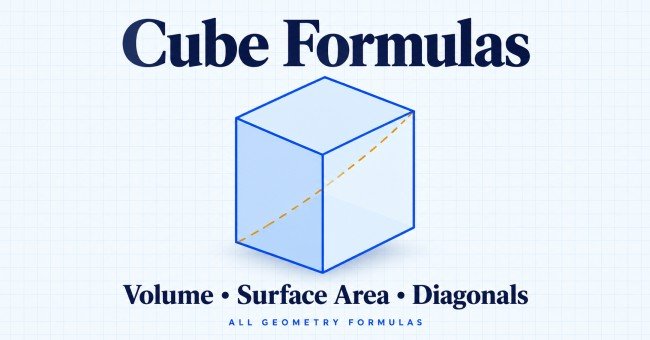
The main cube formulas are volume V = s3 and total surface area SA = 6s2, where s is the length of one edge. The face diagonal is s√2, and the space diagonal through the cube is s√3.
A cube has six equal square faces, twelve equal edges and eight vertices, or corners. Its length, width and height are all equal. Once you know one edge length, you can calculate its volume, face areas and diagonals. The key is choosing whether the question asks about length, area or the space inside.
Cube formulas at a glance
| What to find | Formula | Meaning |
|---|---|---|
| Volume | V = s3 | Space occupied by the cube |
| Total surface area | SA = 6s2 | Area of all six faces |
| Lateral surface area | LSA = 4s2 | Four side faces, excluding top and bottom |
| Area of one face | Aface = s2 | One square face |
| Face diagonal | f = s√2 | Across a single square face |
| Space diagonal | D = s√3 | Through the cube between opposite corners |
| Total edge length | E = 12s | Sum of all twelve edges |
| Edge from volume | s = ∛V | Cube root of the volume |
| Edge from total surface area | s = √(SA/6) | Square root after dividing the total area by six |
| Edge from a diagonal | s = f/√2 or s = D/√3 | Choose the matching diagonal |
Symbols: s = edge length, V = volume, SA = total surface area, LSA = lateral surface area, f = face diagonal and D = space diagonal. Some textbooks use a for the edge length or TSA for total surface area. The formulas are unchanged.
Read the cube diagram
A drawing can make some edges look shorter because of perspective. In the actual cube, all twelve edges have the same length. The slanted lines in the drawing show depth; they do not mean the solid has unequal dimensions.
Volume of a cube
Volume measures three-dimensional space and uses cubic units such as cm3 or m3. For a rectangular solid, volume is length × width × height. A cube has the same measurement in all three directions, so V = s × s × s = s3.
Cubing a number means multiplying it by itself three times. It does not mean multiplying by three. An edge of 4 cm gives 4 × 4 × 4, not 3 × 4.
Example 1: find the volume
A cube has an edge length of 4 cm. Its volume is V = 43 = 64 cm3. You could picture four layers, each holding a 4 by 4 arrangement of unit cubes: 4 × 16 = 64 unit cubes.
Total and lateral surface area
Each face is a square with area s2. A closed cube has six faces, so SA = 6s2. Surface area uses square units because it measures the outside surfaces, rather than the space inside.
If two opposite faces are treated as the top and bottom, the other four make up the lateral surface. Therefore, LSA = 4s2. Read the question carefully: lateral surface area leaves out two faces, while total surface area includes all six.
Example 2: calculate the face areas
For a cube with edge length 5 cm, first square the edge: 52 = 25 cm2. Then count the faces you need:
- One face: 25 cm2.
- Total surface area: 6 × 25 = 150 cm2.
- Lateral surface area: 4 × 25 = 100 cm2.
A box without a lid
For an ideal cube-shaped box with one face missing, the remaining five faces have combined area 5s2. At s = 5 cm, that is 5 × 25 = 125 cm2. This counts the faces only; add any tabs or overlaps if a construction question specifies them.
Face diagonal and space diagonal
A face diagonal joins opposite corners of one square face. By Pythagoras, f2 = s2 + s2 = 2s2. Taking the positive square root gives f = s√2.
A space diagonal, also called a body diagonal, joins two opposite vertices that do not share a face. Use the face diagonal and one more perpendicular edge: D2 = f2 + s2 = 3s2. Therefore, D = s√3. The space diagonal is longer than the face diagonal.
Example 3: calculate both diagonals
The cube’s edge length is 6 cm. Its face diagonal is f = 6√2 cm ≈ 8.49 cm, and its space diagonal is D = 6√3 cm ≈ 10.39 cm. Keep the square roots in the calculation and round only the final answers.
Find an edge length from another measurement
Reverse the formula that matches the information given. Volume requires a cube root. Surface area requires dividing by the number of faces before taking a square root. A diagonal requires division by √2 or √3.
Example 4: find the edge from volume
A cube has volume 343 cm3. Its edge is s = ∛343 = 7 cm, because 7 × 7 × 7 = 343. Its total surface area is then SA = 6 × 72 = 294 cm2.
Example 5: find the edge from surface area
The total surface area is 384 m2. Divide by six to get the area of one face: 384/6 = 64 m2. Then take the square root: s = √64 = 8 m. The volume is V = 83 = 512 m3.
Example 6: find the edge from a diagonal
A cube has a space diagonal of 9√3 cm. Divide by √3 to obtain s = 9 cm. If the given measurement were a face diagonal instead, you would divide by √2.
Total edge length
A cube has twelve edges. Their combined length is E = 12s. For an edge length of 4 cm, E = 48 cm. This is useful when a question asks for a wire frame. It is different from the perimeter of a single face, which is 4s.
Units and changes in size
Use one length unit throughout a calculation. For example, 2 cm equals 20 mm. The corresponding cube volumes are 23 = 8 cm3 and 203 = 8,000 mm3. Cubic units change by a cubed conversion factor.
If every edge is multiplied by a scale factor k, areas multiply by k2 and volume by k3. Doubling an edge makes the surface area four times as large and the volume eight times as large. It does not simply double either result.
Common mistakes to avoid
- Using 3s instead of s3 for volume.
- Using 6s instead of 6s2 for total surface area.
- Confusing the face diagonal s√2 with the space diagonal s√3.
- Taking a square root when finding an edge from volume.
- Writing cubic units for surface area or square units for volume.
Try these practice questions
- A cube has edge length 3 cm. Find its volume, total surface area and lateral surface area.
- A cube has volume 125 cm3. Find its edge length and both diagonal lengths.
- The total surface area is 600 m2. Find the edge length and volume.
Answers: 1) V = 27 cm3, SA = 54 cm2 and LSA = 36 cm2. 2) s = 5 cm, f = 5√2 cm ≈ 7.07 cm and D = 5√3 cm ≈ 8.66 cm. 3) s = 10 m and V = 1,000 m3.
Frequently asked questions
What is the difference between a cube and a cuboid?
A rectangular cuboid has rectangular faces and may have different length, width and height. A cube is the special case in which all three dimensions are equal, making every face a square.
Does a cube have a perimeter?
Perimeter normally describes the boundary of a flat shape. For a cube, specify either the perimeter of one square face, 4s, or the total length of all twelve edges, 12s.
Why does the surface area formula contain six?
A cube has six equal square faces. Each has area s2, so adding them gives 6s2. Four faces give lateral surface area instead.
Should I use a square root or a cube root?
Use s = ∛V when volume is given. Use s = √(SA/6) when the total surface area is given. The units help you choose: volume is cubic, and area is square.
Which diagonal goes through the cube?
The space or body diagonal passes through the interior and has length s√3. A face diagonal stays on one square face and has length s√2.
For the flat shapes used in these calculations, see the square formulas and triangle formulas. Browse the 3D Formulas guides for solid geometry.
Reference texts: OpenStax, Prealgebra 2e, section 9.6; Wolfram MathWorld, Cube and Cuboid; Thomas F. Banchoff, Beyond the Third Dimension, section on cube diagonals. Numerical examples and practice questions were written for this guide.
