
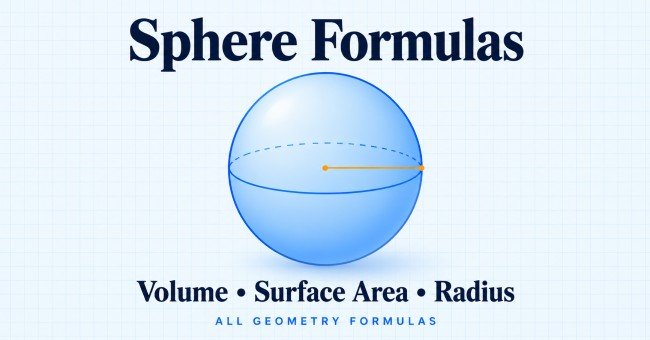
The main sphere formulas are volume V = ⁴⁄₃πr3 and surface area SA = 4πr2, where r is the radius. If diameter d is given instead, use V = πd3/6 and SA = πd2. Diameter is twice the radius.
A sphere is a perfectly round surface with every point the same distance from its centre. In school geometry, “volume of a sphere” means the volume enclosed by that surface. Its size depends on one measurement, the radius, rather than separate length, width and height values.
Sphere formulas at a glance
| What to find | Formula | What you need |
|---|---|---|
| Enclosed volume | V = ⁴⁄₃πr3 | Radius r |
| Surface area | SA = 4πr2 | Radius r |
| Diameter | d = 2r | Radius |
| Radius from diameter | r = d/2 | Diameter d |
| Volume using diameter | V = πd3/6 | Diameter |
| Area using diameter | SA = πd2 | Diameter |
| Radius from volume | r = ∛[3V/(4π)] | Volume |
| Radius from surface area | r = √[SA/(4π)] | Surface area |
| Great-circle circumference | C = 2πr = πd | Radius or diameter |
| Great-circle area | Acircle = πr2 | Radius |
Symbols: V = enclosed volume, SA = surface area, r = radius, d = diameter and C = the circumference of a great circle. Some textbooks use S or A for surface area. Check how each symbol is defined.
Read radius and diameter
Radius runs from the centre to any point on the surface. Diameter joins opposite surface points through the centre. Halve the diameter before using a radius formula. A line across the sphere that misses the centre is a chord, not a diameter.
A plane through the centre cuts out a great circle with the same radius as the sphere. Its circumference is 2πr, and its area is πr2. These are measurements of that circular cross-section, not the sphere’s whole surface.
Volume of a sphere
Volume measures the space enclosed by the sphere and uses cubic units such as cm3 or m3. Use V = ⁴⁄₃πr3: cube the radius, multiply by π, then multiply by four-thirds.
Cubing means r × r × r, not 3 × r. Keep π in exact form during working. Use the calculator’s π button for a decimal answer, unless the question supplies a different approximation.
Example 1: calculate volume
A sphere has radius 4 cm. Its enclosed volume is V = ⁴⁄₃ × π × 43 = 256π/3 cm3 ≈ 268.08 cm3. The fraction form is exact; the decimal is rounded to two decimal places.
Surface area of a sphere
The entire outside surface has area SA = 4πr2. Square the radius here, rather than cubing it. The answer uses square units such as cm2.
This area is four times the area of a great circle with the same radius. A full sphere has no flat circular base to add. Its whole outside surface is curved, so curved surface area and total surface area refer to the same area here.
Example 2: calculate surface area
For radius 4 cm, SA = 4 × π × 42 = 64π cm2 ≈ 201.06 cm2. The area of a circular cross-section through the centre is only 16π cm2. Multiplying that circle area by four gives the sphere’s surface area.
Use diameter instead of radius
Substitute r = d/2 into each formula. For area, 4π(d/2)2 simplifies to SA = πd2. For volume, ⁴⁄₃π(d/2)3 simplifies to V = πd3/6.
Example 3: calculate from diameter
A sphere has diameter 10 cm, so its radius is 5 cm. Its surface area is SA = π × 102 = 100π cm2 ≈ 314.16 cm2.
Its volume is V = π × 103/6 = 500π/3 cm3 ≈ 523.60 cm3. Either the radius or diameter formula works, provided you use the matching measurement.
Find radius from volume or area
Reverse the formula that matches the given measurement. Volume requires a cube root. Surface area requires a square root. Use the positive root because a radius is a length.
Example 4: find radius from volume
The volume is 288π cm3. Rearranging V = ⁴⁄₃πr3 gives r3 = 3V/(4π). Therefore, r = ∛[3 × 288π/(4π)] = ∛216 = 6 cm. The diameter is 12 cm.
Example 5: find radius from surface area
The surface area is 196π cm2. Divide by 4π to get r2 = 49. Taking the square root gives r = 7 cm, so the diameter is 14 cm. Check: 4π × 72 = 196π cm2.
Compare a sphere with a fitting cylinder
A cylinder that just encloses a sphere of radius r has radius r and height 2r. Its volume is 2πr3, so the sphere fills two-thirds of that volume. The cylinder’s curved side has area 2πr × 2r = 4πr2, equal to the sphere’s surface area.
This comparison uses only the cylinder’s curved area, excluding its two circular ends. See the cylinder formulas for the distinction.
Hemisphere: curved area or total area?
A hemisphere is half of a sphere cut through its centre. Its volume is V = ⅔πr3, and its curved surface area is 2πr2.
A closed hemisphere also includes the flat circular cut face. Add πr2 to get total surface area = 3πr2. Halving a sphere’s surface area gives the curved area only, not this total.
Example 6: calculate hemisphere measurements
For a hemisphere with radius 3 cm, the volume is 18π cm3, the curved area is 18π cm2 and the total area including the circular face is 27π cm2. The first two numbers happen to match, but their units and meanings differ.
Units, capacity and scale
Convert all measurements to the required length unit before calculating. For example, a sphere with an internal radius of 10 cm encloses 4,000π/3 cm3 ≈ 4,188.79 cm3. Since 1 litre equals 1,000 cm3, its capacity is about 4.19 litres.
If radius doubles, surface area multiplies by four and volume by eight. More generally, multiplying radius by k multiplies area by k2 and volume by k3. Doubling the diameter has the same effect because radius doubles too.
Common mistakes to avoid
- Using diameter as radius without halving it.
- Using πr2, the area of a circle, for the sphere’s whole surface.
- Squaring the radius in the volume formula instead of cubing it.
- Taking a square root when recovering radius from volume.
- Halving surface area for a hemisphere and forgetting the flat face when total area is required.
Try these practice questions
- A sphere has radius 3 cm. Find its volume and surface area.
- A sphere has diameter 12 cm. Find its surface area.
- The enclosed volume is 500π/3 cm3. Find the radius and diameter.
Answers: 1) V = 36π cm3 and SA = 36π cm2. 2) SA = 144π cm2. 3) r = ∛125 = 5 cm and d = 10 cm.
Frequently asked questions
What is the difference between a circle and a sphere?
A circle is flat, while a sphere is a round surface surrounding a three-dimensional region. Circle area is πr2; sphere surface area is 4πr2.
Does a sphere have a separate height?
A full sphere’s overall height is its diameter, 2r. There is no independent height to enter in its volume formula.
Are curved and total surface area the same?
For a full sphere, yes: all of its surface is curved. A hemisphere needs a separate decision about whether to include the flat circular face.
Does a sphere have a perimeter?
There is no single flat boundary around a sphere. If a question means the circumference around a great circle, use C = 2πr.
Is a hemisphere’s total area half a sphere’s?
Its curved area is half. Including the flat circular face increases the total to 3πr2.
For the base circle and circumference calculations, see the circle formulas. Browse all 3D Formulas guides.
Reference texts: OpenStax, Prealgebra 2e, section 9.6, and University Physics Volume 2, Appendix E; Wolfram MathWorld, Sphere. Numerical examples and practice questions were written for this guide.
