
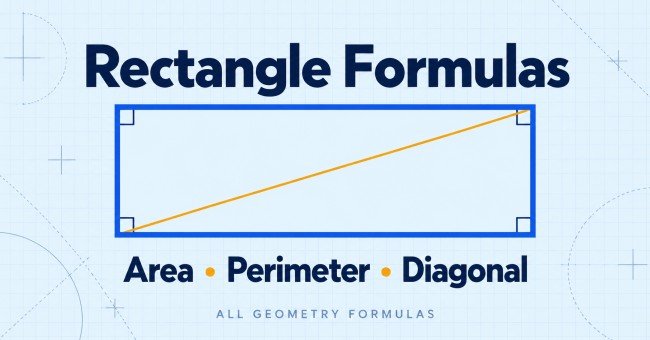
The main rectangle formulas are area A = L × W, perimeter P = 2(L + W) and diagonal d = √(L2 + W2). Here, L is the length and W is the width. A rectangle has four right angles, and each pair of opposite sides has the same length.
Choose the formula that matches what you need to measure. Area gives the space inside the rectangle, perimeter gives the distance around its boundary, and the diagonal gives the straight distance between opposite corners. This guide includes a quick formula table, a labelled diagram and examples with missing sides, unit conversions and practical measurements.
Rectangle formulas at a glance
| What to find | Formula | Measurements needed |
|---|---|---|
| Area | A = LW | Length L and width W |
| Perimeter | P = 2(L + W) | Length L and width W |
| Diagonal | d = √(L2 + W2) | Length L and width W |
| Length from area | L = A/W | Area A and width W |
| Width from area | W = A/L | Area A and length L |
| Length from perimeter | L = P/2 − W | Perimeter P and width W |
| Width from perimeter | W = P/2 − L | Perimeter P and length L |
| Width from diagonal | W = √(d2 − L2) | Diagonal d and length L |
| Length from diagonal | L = √(d2 − W2) | Diagonal d and width W |
Symbols: L = length, W = width, A = area, P = perimeter and d = diagonal. L and W are adjacent sides. Their names do not change the result: multiplying 8 × 6 gives the same area as multiplying 6 × 8.
Parts and properties of a rectangle
A rectangle is a quadrilateral with four 90° angles. Its opposite sides are equal and parallel. The two diagonals have the same length and cross at their midpoints. A diagonal divides the rectangle into two equal right-angled triangles.
Area of a rectangle
To find area, multiply the two adjacent side lengths: A = L × W. A rectangle that measures 8 cm by 6 cm has an area of 8 × 6 = 48 cm2.
Picture the shape as six rows of eight small squares, each 1 cm by 1 cm. The 48 squares cover its surface. This is why area uses square units, such as cm2 and m2, rather than length units alone.
Use area for tasks such as finding the size of a tabletop, calculating floor coverage or measuring a rectangular sheet of paper. Make sure the length and width use the same unit before multiplying.
Perimeter of a rectangle
The perimeter includes all four edges. Adding them gives L + W + L + W. Combining the equal pairs gives P = 2L + 2W = 2(L + W).
For an 8 cm by 6 cm rectangle, P = 2(8 + 6) = 28 cm. You can check this by adding 8 + 6 + 8 + 6. Perimeter uses length units because it measures a boundary, not a surface.
A fence around a rectangular garden or trim around a picture frame depends on perimeter. If a problem excludes a gate or an opening, subtract that length after calculating the full boundary.
Diagonal of a rectangle
A diagonal is the straight line from one corner to the opposite corner. Together with the length and width, it forms a right-angled triangle. The diagonal is the hypotenuse, so the Pythagorean theorem gives d2 = L2 + W2.
Take the positive square root to obtain d = √(L2 + W2). Square each side first, add the results, then take the square root. Do not add the sides and square the total.
For any rectangle with positive side lengths, the diagonal is longer than either side. It is still a length, so an answer calculated from centimetres is in cm, not cm2.
Worked examples
Example 1: Find area, perimeter and diagonal
A rectangular card measures 8 cm long and 6 cm wide.
- Area: A = 8 × 6 = 48 cm2.
- Perimeter: P = 2(8 + 6) = 28 cm.
- Diagonal: d = √(82 + 62) = √(64 + 36) = √100 = 10 cm.
The 10 cm diagonal is longer than both edges.
Example 2: Find width from area
A rectangular poster has area 84 cm2 and length 12 cm. Divide the area by the known side: W = A/L = 84/12 = 7 cm.
Check by multiplying: 12 × 7 = 84 cm2. Its perimeter is P = 2(12 + 7) = 38 cm.
Example 3: Find width from perimeter
A rectangle has perimeter 42 m and length 12 m. Half its perimeter is the sum of one length and one width.
- Divide by two: L + W = 42/2 = 21 m.
- Subtract the known length: W = 21 − 12 = 9 m.
- Find area: A = 12 × 9 = 108 m2.
Checking all four sides gives 12 + 9 + 12 + 9 = 42 m. Its diagonal is √(144 + 81) = √225 = 15 m.
Example 4: Find a side from the diagonal
A rectangular panel has diagonal 13 cm and length 12 cm. Rearrange the Pythagorean theorem to find the width.
W = √(d2 − L2) = √(132 − 122) = √(169 − 144) = √25 = 5 cm.
The panel’s area is 12 × 5 = 60 cm2, and its perimeter is 2(12 + 5) = 34 cm. The 13 cm diagonal is longer than each side, as expected.
Example 5: Convert units before finding tile coverage
A rectangular floor measures 4.5 m by 3 m. Square tiles have side length 50 cm. Find the number of tiles for exact coverage, ignoring gaps, breakages and cutting waste.
- Convert the tile side: 50 cm = 0.5 m.
- Find the floor area: 4.5 × 3 = 13.5 m2.
- Find one tile’s area: 0.5 × 0.5 = 0.25 m2.
- Divide the areas: 13.5/0.25 = 54 tiles.
Nine tiles fit along the length and six fit along the width, so 9 × 6 confirms the answer. This calculation gives the mathematical coverage; an actual order may allow for spare tiles.
Rectangle and square: what changes?
A square is a special rectangle whose four sides are equal. If L = W = s, the rectangle formulas become A = s2, P = 4s and d = s√2. See the square formulas guide for examples.
For a rectangle with unequal adjacent sides, use both measurements. One side alone is not enough to determine its area or perimeter unless the question supplies another relationship.
Common mistakes to avoid
- Using L + W as the whole perimeter. Multiply that sum by two.
- Using 2(L + W) for area. Area is L × W.
- Mixing units without converting them first.
- Using the diagonal as the length or width.
- Writing d = L + W. The diagonal uses a square root of squared side lengths.
- Assuming the diagonal alone determines the area of every rectangle.
Try these practice questions
- A rectangle measures 9 cm by 4 cm. Find its area, perimeter and diagonal.
- A rectangle has area 72 m2 and width 8 m. Find its length and perimeter.
- A rectangle has diagonal 17 cm and length 15 cm. Find its width.
Answers: 1) A = 36 cm2, P = 26 cm and d = √97 cm ≈ 9.85 cm. 2) L = 9 m and P = 34 m. 3) W = √(289 − 225) = 8 cm.
Frequently asked questions
What is the area formula for a rectangle?
Multiply the length by the width: A = L × W. Use matching length units and write the result in square units.
How do I find perimeter from length and width?
Add the length and width, then multiply by two: P = 2(L + W). This includes both pairs of opposite sides.
Can I find area from the diagonal alone?
Not for a general rectangle. Different side lengths can give the same diagonal. You also need another measurement or a condition, such as a known side ratio or the fact that it is a square.
Is a rectangle’s diagonal always longer than its sides?
Yes, for a rectangle with positive side lengths. Since d2 = L2 + W2, the positive diagonal is longer than L and longer than W.
Does a rectangle have a volume formula?
A rectangle is two-dimensional and has no volume. A rectangular prism, also called a cuboid, is three-dimensional and uses length, width and height to calculate volume.
Explore the triangle formulas guide and the circle formulas guide, browse all 2D Formulas guides, or use the homepage formula table for a quick comparison.
Reference texts: OpenStax, Prealgebra 2e, section 9.4, “Use Properties of Rectangles, Triangles, and Trapezoids”, Appendix C, “Geometric Formulas”, and section 9.3 on the Pythagorean theorem. The examples and practice questions were written for this guide.
