
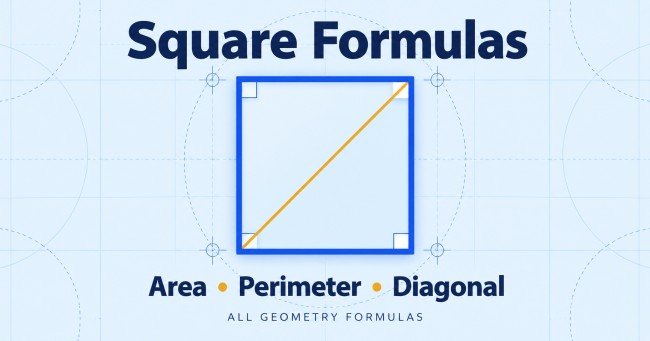
The main square formulas are area A = s2, perimeter P = 4s and diagonal d = s√2. Here, s is the length of one side. A square has four equal sides and four right angles, so one side measurement is enough to calculate all three quantities.
Use area when you need the space inside a square, perimeter when you need the distance around it, and diagonal when you need the distance between opposite corners. The guide below includes a formula table, a labelled diagram and worked examples using sides, perimeter, area and diagonal measurements.
Square formulas at a glance
| What to find | Formula | Given measurement |
|---|---|---|
| Area | A = s2 | Side s |
| Perimeter | P = 4s | Side s |
| Diagonal | d = s√2 | Side s |
| Side from perimeter | s = P/4 | Perimeter P |
| Side from area | s = √A | Area A |
| Side from diagonal | s = d/√2 | Diagonal d |
| Area from diagonal | A = d2/2 | Diagonal d |
| Area from perimeter | A = P2/16 | Perimeter P |
| Perimeter from area | P = 4√A | Area A |
Symbols: s = side length, A = area, P = perimeter and d = diagonal. The value √2 is approximately 1.41421. Use its full calculator value and round only the final answer.
Parts and properties of a square
Each side of a square has the same length. Every interior angle is 90°. Its two diagonals are equal in length, cross at their midpoints and meet at right angles. Each diagonal also divides the square into two equal right-angled triangles.
Area of a square
Area measures the surface inside the square. Multiply its side length by itself: A = s × s = s2. If the side is 8 cm, the area is 8 × 8 = 64 cm2.
The answer uses square units, such as cm2 or m2. You can imagine the 8 cm square as eight rows of eight small squares, each measuring 1 cm by 1 cm. Together, they make 64 square centimetres.
Perimeter of a square
Perimeter is the total length of the boundary. Add the four equal sides or multiply one side by four: P = s + s + s + s = 4s.
For the same 8 cm square, P = 4 × 8 = 32 cm. Perimeter uses length units, not square units. A fence around a square garden depends on perimeter; the amount of lawn inside depends on area.
Diagonal of a square
The diagonal runs from one corner to the opposite corner. It is the hypotenuse of a right-angled triangle whose other two sides both have length s.
By the Pythagorean theorem, d2 = s2 + s2 = 2s2. Taking the positive square root gives d = s√2. For a side of 8 cm, d = 8√2 cm ≈ 11.31 cm.
Keep the units outside the square root. The diagonal is a length, so the answer is in cm, even though squared lengths appear during the calculation.
Worked examples
Example 1: Find area, perimeter and diagonal from a side
A square coaster has side length 6 cm. Find all three measurements.
- Area: A = 62 = 36 cm2.
- Perimeter: P = 4 × 6 = 24 cm.
- Diagonal: d = 6√2 cm ≈ 8.49 cm.
These answers describe different parts of the same shape. The area tells you its surface size, while the perimeter and diagonal give two different lengths.
Example 2: Find the side and area from perimeter
A square frame has perimeter 36 cm. Since all four sides are equal, divide the perimeter by four.
Side: s = 36/4 = 9 cm. Area: A = 92 = 81 cm2.
You can check the side by adding it four times: 9 + 9 + 9 + 9 = 36 cm. The shortcut A = P2/16 also gives 362/16 = 81 cm2.
Example 3: Find perimeter from area
A square piece of fabric has area 196 cm2. Take the square root to find its side: s = √196 = 14 cm. Then multiply by four: P = 4 × 14 = 56 cm.
Do not divide the area by four to find a side. Area comes from multiplying two lengths, so its reverse calculation requires a square root.
Example 4: Find area from diagonal
A square has a diagonal of 10 m. Use A = d2/2. Its area is 102/2 = 100/2 = 50 m2.
Its side is s = 10/√2 = 5√2 m ≈ 7.07 m. Its exact perimeter is 20√2 m, approximately 28.28 m. Keep the exact side length in your calculation instead of rounding it before finding perimeter.
Example 5: Square tiles and unit conversion
A square floor has side length 4 m. It will be covered with square tiles whose sides measure 50 cm. How many whole tiles cover the floor, ignoring gaps and cutting waste?
- Convert the tile side to metres: 50 cm = 0.5 m.
- Find the floor area: 42 = 16 m2.
- Find one tile’s area: 0.52 = 0.25 m2.
- Divide: 16/0.25 = 64 tiles.
A second check gives the same result: eight tiles fit along each side of the floor, so 8 × 8 = 64. Actual purchases may need extra tiles for breakages or layout changes; this example counts the exact surface coverage.
How changing the side affects the square
If you double a square’s side, its perimeter doubles and its area becomes four times as large. For example, increasing the side from 3 cm to 6 cm changes the perimeter from 12 cm to 24 cm, and the area from 9 cm2 to 36 cm2.
More generally, multiplying the side by a positive scale factor k multiplies the perimeter and diagonal by k, while the area is multiplied by k2.
Common mistakes to avoid
- Using 4s for area. It gives perimeter; area is s2.
- Treating s2 as 2s. For s = 6, the square is 36, not 12.
- Using the diagonal as a side. Divide the diagonal by √2 first, or use A = d2/2.
- Mixing centimetres and metres in the same calculation. Convert the measurements to matching units.
- Writing cm2 for a perimeter or cm for an area.
- Rounding an intermediate value before the calculation is complete.
Try these practice questions
- A square has side length 5 cm. Find its area, perimeter and diagonal.
- A square has perimeter 48 m. Find its side length and area.
- A square has diagonal 12 cm. Find its area.
Answers: 1) A = 25 cm2, P = 20 cm and d = 5√2 cm ≈ 7.07 cm. 2) s = 12 m and A = 144 m2. 3) A = 122/2 = 72 cm2.
Frequently asked questions
What is the formula for a square’s area?
Multiply one side by itself: A = s2. If you know the diagonal instead, use A = d2/2.
How do I find the area from perimeter?
Find the side using s = P/4, then square it. Combining these two steps gives A = P2/16.
Is a square also a rectangle?
Yes. A rectangle has four right angles, and a square meets that definition. A square also has four equal sides. A rectangle whose adjacent sides have different lengths is not a square.
Is a square’s diagonal equal to its side?
No. The diagonal is √2 times the side length, or about 1.41421 times as long. Use d = s√2.
Does a square have volume?
A square is a flat, two-dimensional shape, so it has area and perimeter, but no volume. A cube is three-dimensional. See the cube formulas for its volume and surface area.
Compare these with the rectangle formulas and examples or the circle formulas for area and circumference, browse the 2D Formulas guides, or return to the homepage formula table.
Reference texts: OpenStax, Prealgebra 2e, Appendix C, “Geometric Formulas”, and section 9.3, “Use Properties of Angles, Triangles, and the Pythagorean Theorem”. The worked examples and practice questions were written for this guide.
