
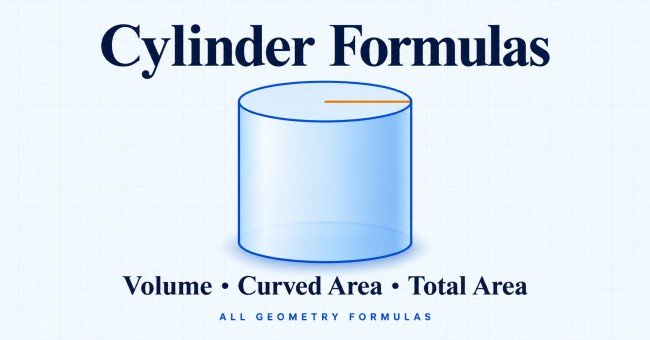
The main cylinder formulas are volume V = πr2h, curved surface area CSA = 2πrh and total surface area SA = 2πr2 + 2πrh. Here, r is the radius and h is the perpendicular height. Total surface area includes both circular bases.
These formulas describe a right circular cylinder: two equal, parallel circular bases joined by a curved side, with the axis perpendicular to the bases. A closed cylinder has both end faces. An open-top cylinder has only one. Count the surfaces before choosing an area formula.
Cylinder formulas at a glance
| What to find | Formula | When to use it |
|---|---|---|
| Volume | V = πr2h | Radius and perpendicular height |
| Curved or lateral surface area | CSA = 2πrh | Curved side only |
| Total surface area | SA = 2πr2 + 2πrh | Closed cylinder with both bases |
| Area of one base | B = πr2 | One circular face |
| Base circumference | C = 2πr | Distance around one circular rim |
| Diameter and radius | d = 2r; r = d/2 | Convert between the two measurements |
| Volume using diameter | V = πd2h/4 | Diameter d and height h |
| Height from volume | h = V/(πr2) | Volume and radius |
| Radius from volume | r = √[V/(πh)] | Volume and height |
| Height from curved area | h = CSA/(2πr) | Curved area and radius |
| Area with one end open | A = πr2 + 2πrh | One base plus the curved side |
Symbols: V = volume, SA = total surface area, CSA = curved surface area, r = radius, d = diameter and h = height. LSA, meaning lateral surface area, is another name for CSA here. Some textbooks use TSA for total surface area.
Read the radius and height
Radius measures from the centre of a base to its edge. Diameter crosses the whole circle through the centre, so it is twice the radius. If a question gives diameter, halve it before using a formula written with r.
Height measures the perpendicular distance between the bases. For a right cylinder, it is also the length of a straight line down the curved side, parallel to the axis.
Volume of a cylinder
Volume is base area multiplied by height. A circular base has area πr2, giving V = πr2h. This follows the same V = Bh idea used for a rectangular prism, but the base is a circle rather than a rectangle.
The answer uses cubic units, such as cm3 or m3. Square the radius before multiplying by the height. Use the π button on your calculator and round at the end, unless the question specifies a value for π.
Example 1: calculate volume
A cylinder has radius 3 cm and height 10 cm. Substitute these values: V = π × 32 × 10 = 90π cm3 ≈ 282.74 cm3. The exact answer is 90π; the decimal is an approximation.
Curved surface area
Imagine cutting the curved side along a vertical line and unrolling it. It becomes a rectangle. Its width is the base circumference, 2πr, and its height is h. Therefore, CSA = 2πr × h = 2πrh.
This measures only the curved side, such as the area covered by a label around a cylindrical container. It excludes the two circular ends and uses square units.
Example 2: calculate curved area
For radius 3 cm and height 10 cm, the curved area is CSA = 2π × 3 × 10 = 60π cm2 ≈ 188.50 cm2. No circular base area is added.
Total surface area
A closed cylinder has the curved side and two circular bases. Each base has area πr2, so SA = 2πr2 + 2πrh = 2πr(r + h). Both versions give the same result.
Example 3: calculate total area
Use the same radius of 3 cm and height of 10 cm. The two bases have combined area 2π × 9 = 18π cm2. Adding the curved area gives SA = 18π + 60π = 78π cm2 ≈ 245.04 cm2.
Open-top and open-ended cylinders
For an ideal cylinder with no lid but with a circular bottom, include one base: A = πr2 + 2πrh. For a curved sheet with both ends open, include neither base: A = 2πrh.
At r = 3 cm and h = 10 cm, the open-top area is 9π + 60π = 69π cm2 ≈ 216.77 cm2. These are ideal surface calculations. A thick-walled pipe also has inner surfaces and rim areas, which need separate measurements.
When the diameter is given
Since r = d/2, replacing r in the volume formula gives V = π(d/2)2h = πd2h/4. The divisor is four because the entire d/2 is squared.
Example 4: use a diameter
A cylinder has diameter 8 cm and height 12 cm. Its radius is 4 cm. The volume is V = π × 42 × 12 = 192π cm3 ≈ 603.19 cm3. The diameter version gives the same result: π × 82 × 12/4.
Find a missing height or radius
Rearrange the volume formula according to the missing measurement. Divide by the base area for height. For radius, first divide volume by πh, then take the positive square root.
Example 5: find height from volume
The volume is 200π cm3 and the radius is 5 cm. Therefore, h = 200π/(π × 52) = 200/25 = 8 cm. The π terms cancel, so no decimal approximation is needed.
Example 6: find radius from volume
The volume is 144π cm3 and the height is 9 cm. Then r2 = 144π/(9π) = 16, giving r = 4 cm. The diameter would be 8 cm.
Height from a surface area
For curved area, use h = CSA/(2πr). For total area, subtract the two bases first: h = (SA − 2πr2)/(2πr). For example, SA = 80π cm2 and r = 4 cm give h = (80π − 32π)/(8π) = 6 cm.
Units and capacity
Convert radius and height to the same length unit before calculating. A cylinder with radius 0.1 m and height 20 cm has radius 10 cm. Its volume is π × 102 × 20 = 2,000π cm3.
Since 1 litre equals 1,000 cm3, that volume is 2π litres, or about 6.28 litres. Use internal measurements for a container’s capacity.
Common mistakes to avoid
- Using diameter as radius, or forgetting to square the radius.
- Adding base areas when the question asks for curved area only.
- Including two bases when the cylinder has only one end face.
- Writing square units for volume or cubic units for area.
- Rounding π or intermediate answers too early.
Try these practice questions
- A cylinder has radius 3 cm and height 4 cm. Find its volume, curved area and total surface area.
- A cylinder has diameter 10 cm and height 8 cm. Find its volume.
- The volume is 72π cm3 and the height is 8 cm. Find the radius.
Answers: 1) V = 36π cm3, CSA = 24π cm2 and SA = 42π cm2. 2) V = 200π cm3. 3) r = √[72π/(8π)] = 3 cm.
Frequently asked questions
Is radius half the diameter?
Yes. Radius runs from the centre to the edge, while diameter runs across the whole circle through its centre. Use r = d/2.
Are curved area and lateral area the same?
For a right circular cylinder, yes. Both mean the area of the curved side, 2πrh, excluding the circular bases.
Which formula should I use for an open-top cylinder?
Use πr2 + 2πrh when there is one circular bottom and no lid. If both end faces are absent, the ideal curved sheet has area 2πrh.
Can I find radius from volume alone?
No. Different radii and heights can give the same volume. You also need height or another condition linking the measurements.
Do these formulas work for an oblique cylinder?
Volume remains base area × perpendicular height for an oblique circular cylinder. However, its curved area is not generally 2πrh. The surface area formulas in this guide assume a right cylinder.
For the base calculations, see the circle formulas. The unrolled curved side uses the rectangle area formula. Browse all 3D Formulas guides.
Reference texts: OpenStax, Prealgebra 2e, section 9.6, and Contemporary Mathematics, section 10.7; Wolfram MathWorld, Cylinder. Numerical examples and practice questions were written for this guide.
