
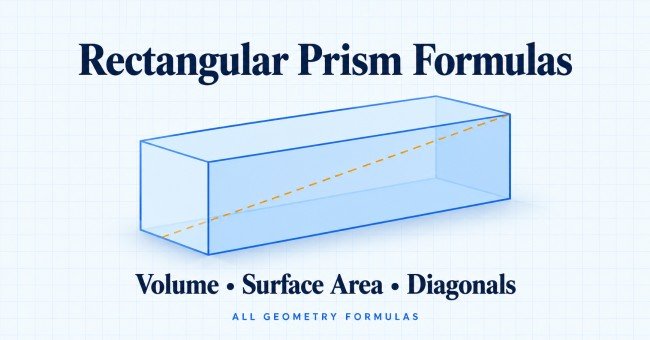
The main rectangular prism formulas are volume V = lwh and total surface area SA = 2(lw + lh + wh). Here, l is length, w is width and h is height. The space diagonal is D = √(l2 + w2 + h2).
This guide covers the right rectangular prism, commonly called a cuboid. It has six rectangular faces, twelve edges and eight vertices. Opposite faces are equal, and edges meet at right angles. Its dimensions need not all be equal.
Rectangular prism formulas at a glance
| What to find | Formula | What it measures |
|---|---|---|
| Volume | V = lwh | Space occupied by the prism |
| Total surface area | SA = 2(lw + lh + wh) | All six faces |
| Lateral surface area | LSA = 2h(l + w) | Four side faces when the base is l × w |
| Base area | B = lw | One length-by-width face |
| Base face diagonal | flw = √(l2 + w2) | Across the l × w face |
| Other face diagonals | flh = √(l2 + h2); fwh = √(w2 + h2) | Across the other two face types |
| Space diagonal | D = √(l2 + w2 + h2) | Through the solid between opposite corners |
| Height from volume | h = V/(lw) | Volume divided by base area |
| Height from total surface area | h = (SA/2 − lw)/(l + w) | Total area and the two base dimensions |
| Total edge length | E = 4(l + w + h) | Sum of all twelve edges |
Symbols: V = volume, SA = total surface area, LSA = lateral surface area and B = base area. The subscripts on a face diagonal identify the two dimensions used. Some textbooks write TSA instead of SA.
Read the length, width and height
Choose an l × w face as the base. Height h is the perpendicular distance to the opposite face. Slanted lines in this perspective drawing show depth.
Volume of a rectangular prism
Multiply length, width and height: V = l × w × h. Equivalently, V = Bh, where B = lw is the base area.
Volume uses cubic units, such as cm3 or m3. All three lengths must use the same unit before multiplication.
Example 1: calculate the volume
A cuboid has length 8 cm, width 5 cm and height 3 cm. Its base area is 8 × 5 = 40 cm2. Therefore, V = 8 × 5 × 3 = 120 cm3.
Total surface area
There are three pairs of equal opposite faces. The top and bottom each have area lw. The front and back each have area lh. The two remaining faces each have area wh. Adding all six gives SA = 2lw + 2lh + 2wh.
Factor out the two to obtain SA = 2(lw + lh + wh). Surface area uses square units because it measures the faces, rather than the space inside.
Example 2: calculate the total surface area
Use the same 8 cm by 5 cm by 3 cm cuboid. Calculate the three different face areas first:
- Length × width: 8 × 5 = 40 cm2.
- Length × height: 8 × 3 = 24 cm2.
- Width × height: 5 × 3 = 15 cm2.
There are two of each face, so SA = 2(40 + 24 + 15) = 158 cm2.
Lateral surface area and an open-top box
With the l × w face chosen as the base, lateral surface area excludes the top and bottom. The four side faces give LSA = 2lh + 2wh = 2h(l + w).
For the 8 cm by 5 cm by 3 cm cuboid, LSA = 2 × 3 × (8 + 5) = 78 cm2.
An open-top box keeps the bottom but loses the lid. Its five-face area is lw + 2lh + 2wh. In this example, it is 40 + 48 + 30 = 118 cm2. This counts the faces only; construction tabs or overlaps need to be added if the question gives them.
Find a missing dimension
If volume and two dimensions are known, divide the volume by their product. For example, h = V/(lw). Similarly, l = V/(wh) and w = V/(lh). Dividing a cubic measurement by a square measurement leaves a length.
Example 3: find height from volume
A prism has volume 360 cm3, length 12 cm and width 6 cm. Its height is h = 360/(12 × 6) = 5 cm. Check by multiplying: 12 × 6 × 5 = 360 cm3.
Example 4: find height from surface area
The total surface area is 208 cm2, length is 8 cm and width is 4 cm. Start with SA/2 = lw + h(l + w), then rearrange:
h = (208/2 − 8 × 4)/(8 + 4) = (104 − 32)/12 = 6 cm. Checking gives SA = 2(32 + 48 + 24) = 208 cm2.
Face diagonals and the space diagonal
A face diagonal stays on one rectangular face. Apply Pythagoras to the two dimensions of that face. For example, the l × w face has diagonal flw = √(l2 + w2). Use l and h, or w and h, for the other face types.
The space diagonal, also called the body diagonal, joins opposite corners through the interior. Combine a base face diagonal with the perpendicular height: D2 = flw2 + h2. Therefore, D = √(l2 + w2 + h2).
Example 5: calculate a diagonal through the box
Let length = 3 cm, width = 4 cm and height = 12 cm. The base face diagonal is √(32 + 42) = 5 cm. The space diagonal is D = √(52 + 122) = √169 = 13 cm.
If instead D, l and w are known, rearrange to h = √(D2 − l2 − w2). Here, √(169 − 9 − 16) = 12 cm. A positive height is required for a non-flat prism.
Total edge length
There are four edges of each dimension, so their combined length is E = 4(l + w + h). An 8 cm by 5 cm by 3 cm wire frame needs 4(8 + 5 + 3) = 64 cm along its edges. This is not surface area or the perimeter of one face.
Units and capacity
Convert mixed lengths before using a formula. For a box measuring 0.5 m by 30 cm by 20 cm, change 0.5 m to 50 cm. The volume is 50 × 30 × 20 = 30,000 cm3, or 30 litres, because 1 litre equals 1,000 cm3.
Use internal dimensions for a container’s capacity. External dimensions also include its walls.
Common mistakes to avoid
- Adding l, w and h when the question asks for volume.
- Adding only three face areas and forgetting their opposite faces.
- Using the cube formula 6s2 when the three dimensions are unequal.
- Using only two dimensions for a space diagonal.
- Mixing length units or confusing square units with cubic units.
Try these practice questions
- A cuboid measures 7 cm by 4 cm by 2 cm. Find its volume, total surface area and lateral surface area, using the 7 × 4 face as the base.
- The volume is 480 m3, length is 10 m and width is 8 m. Find the height.
- A rectangular prism measures 2 cm by 3 cm by 6 cm. Find its space diagonal.
Answers: 1) V = 56 cm3, SA = 100 cm2 and LSA = 44 cm2. 2) h = 6 m. 3) D = √(4 + 9 + 36) = 7 cm.
Frequently asked questions
Are cuboid and rectangular prism the same here?
Yes. This guide uses cuboid to mean a right rectangular prism with six rectangular faces. A cube is the special case with equal length, width and height.
Why is surface area multiplied by two?
Each face has an equal opposite face. There are two lw faces, two lh faces and two wh faces, giving 2(lw + lh + wh).
Can volume alone give all three dimensions?
No. Many different cuboids can have the same volume. You need more measurements or a condition such as all three dimensions being equal.
Does turning the box change its surface area?
Volume and total surface area stay the same when the box is rotated. Lateral surface area can change if you choose a different pair of faces as the top and bottom.
Are all face diagonals equal?
Not generally. Their lengths depend on the dimensions of each face. The four space diagonals are equal to one another and use all three dimensions.
Compare with the cube formulas when all three dimensions are equal. For circular bases, see the cylinder formulas. For the face calculations, see the rectangle formulas, or browse all 3D Formulas guides.
Reference texts: OpenStax, Prealgebra 2e, section 9.6, and Contemporary Mathematics, sections 9.3 and 10.7; Wolfram MathWorld, Cuboid. Numerical examples and practice questions were written for this guide.
