
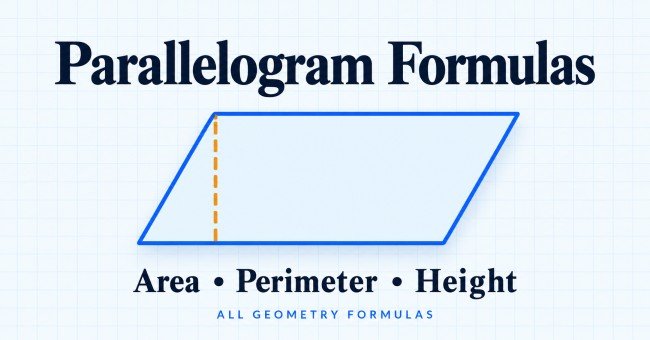
The main parallelogram formulas are area A = bh and perimeter P = 2(a + b). Here, b is the base, h is the perpendicular height and a is the adjacent side. The sloping side is usually not the height.
A parallelogram has two pairs of parallel opposite sides. Opposite sides have equal lengths. Area uses the shortest distance between the parallel bases. This guide explains which measurements to choose and how to use them.
Parallelogram formulas at a glance
| What to find | Formula | Measurements needed |
|---|---|---|
| Area | A = bh | Base b and perpendicular height h |
| Perimeter | P = 2(a + b) | Two adjacent side lengths a and b |
| Height | h = A/b | Area and matching base |
| Base | b = A/h | Area and matching height |
| Missing adjacent side | a = P/2 − b | Perimeter and side b |
| Area from sides and angle | A = ab sin θ | Adjacent sides and the angle between them |
| Height from side and angle | h = a sin θ | Side a and included angle θ |
| Adjacent interior angle | 180° − θ | One interior angle θ |
Symbols: A means area, P means perimeter, a and b are adjacent sides, h is the height corresponding to base b, and θ is the interior angle between a and b. All side lengths must use the same unit before you calculate.
Base, side and height: read the diagram
Either pair of parallel sides can act as the bases. Once you choose a base, measure its height at a right angle to that base. If you rotate the shape, the base may look vertical or slanted on the page. The rule still depends on a 90° measurement, rather than how the drawing is positioned.
The height may fall inside the parallelogram or meet an extension of the base outside it. In both cases, it measures the perpendicular distance between the two parallel lines. A sloping edge can be used as the height only when it is perpendicular to the chosen base, as in a rectangle.
Area of a parallelogram
To find the area, multiply the base by its matching perpendicular height: A = b × h. Area describes the surface inside the boundary, so the answer uses square units such as cm2 or m2.
You can understand the formula by cutting a triangular piece from one end of a parallelogram and moving it to the other end. This forms a rectangle with the same base and height. The pieces have only moved, so the area stays the same. You do not divide by two, as you would for a triangle.
Example 1: find the area
A parallelogram has a base of 12 cm and a perpendicular height of 7 cm. Substitute these measurements into the area formula:
A = bh = 12 × 7 = 84 cm2. The base is a length, while the final answer is an area.
Perimeter of a parallelogram
Perimeter is the total distance around the four edges. The two pairs of equal opposite sides give a + b + a + b. Collecting these terms gives P = 2a + 2b = 2(a + b). Use the actual side lengths here, including the sloping edge.
Example 2: find area and perimeter together
Suppose the base is 10 cm, the adjacent side is 5 cm and the perpendicular height is 4 cm. The three measurements have different jobs:
- Area: A = 10 × 4 = 40 cm2.
- Perimeter: P = 2(10 + 5) = 30 cm.
Using 10 × 5 would give the wrong area because 5 cm is the side, not the perpendicular height. Using 2(10 + 4) would give the wrong perimeter because the height is not one of the boundary edges.
Find a missing height, base or side
Rearrange the formula that contains the measurements you know. To recover height from area, divide by the base. To recover the base, divide by the height. For a missing adjacent side, first halve the perimeter, then subtract the known side.
Example 3: find the height
The area is 96 m2 and the base is 12 m. The height is h = A/b = 96/12 = 8 m. Check the result by multiplying: 12 × 8 = 96 m2.
Example 4: find the base
The area is 63 cm2 and the matching height is 7 cm. Therefore, b = A/h = 63/7 = 9 cm. Dividing square centimetres by centimetres leaves a length in centimetres.
Example 5: find a missing side
The perimeter is 46 cm and one side is 15 cm. The adjacent side is a = P/2 − b = 46/2 − 15 = 8 cm. The four edges are 15, 8, 15 and 8 cm, which add to 46 cm.
Area from two sides and an angle
If the perpendicular height is missing but two adjacent sides and their included angle are known, use A = ab sin θ. The included angle is the angle where those two sides meet. This works because h = a sin θ, so bh becomes ab sin θ.
For an angle given in degrees, set your calculator to degree mode. Entering a degree value while the calculator is in radian mode changes the result.
Example 6: use the sine formula
Adjacent sides are 8 cm and 12 cm, with an included angle of 30°. Since sin 30° = ½, the area is A = 8 × 12 × ½ = 48 cm2. The height relative to the 12 cm base is h = 8 × ½ = 4 cm, giving the same area: 12 × 4 = 48 cm2.
Angles and diagonals
Opposite interior angles in a parallelogram are equal. Adjacent interior angles add to 180°. For example, if one angle is 65°, each neighbouring angle is 115°, and the opposite angle is 65°.
The diagonals join opposite vertices and bisect each other: each diagonal is cut into two equal parts at the intersection. They are not generally equal in length or perpendicular.
For adjacent sides a and b with included angle θ, the two diagonal lengths are d1 = √(a2 + b2 + 2ab cos θ) and d2 = √(a2 + b2 − 2ab cos θ). Use the plus sign for one diagonal and the minus sign for the other. Neither expression always represents the longer diagonal; that depends on θ.
A useful check is d12 + d22 = 2(a2 + b2). This relationship is called the parallelogram law.
Example 7: calculate both diagonals
Let a = 5 cm, b = 8 cm and θ = 60°. Since cos 60° = ½, a2 + b2 = 89 and 2ab cos θ = 40. The diagonal lengths are √129 cm ≈ 11.36 cm and √49 cm = 7 cm. Their squared lengths add to 129 + 49 = 178, which equals 2(25 + 64).
Common mistakes to avoid
- Multiplying the base by a sloping side when the question requires perpendicular height.
- Dividing bh by two. That gives the area of a triangle with the same base and height.
- Using square units for perimeter or ordinary length units for area.
- Mixing units. For example, change 50 mm to 5 cm before multiplying it by a base measured in centimetres.
- Assuming the diagonals are equal or meet at 90° in every parallelogram.
Try these practice questions
- A parallelogram has base 14 cm, height 6 cm and adjacent side 8 cm. Find its area and perimeter.
- The area is 135 m2 and the base is 15 m. Find the perpendicular height.
- Two adjacent sides are 6 cm and 10 cm, with an included angle of 30°. Find the area.
Answers: 1) A = 84 cm2 and P = 44 cm. 2) h = 9 m. 3) A = 6 × 10 × ½ = 30 cm2.
Frequently asked questions
What is the difference between area and perimeter?
Area measures the surface inside the parallelogram and uses square units. Perimeter measures the distance around its edges and uses length units.
Can I find area from two side lengths alone?
Not for a general parallelogram. The angle can change while the side lengths stay fixed, giving different heights and areas. You need another measurement or condition, such as a height, included angle or right angle.
Is every rectangle a parallelogram?
Yes. A rectangle has two pairs of parallel opposite sides and four right angles. Its height equals the adjacent side length, so the parallelogram area formula becomes length × width.
Are a parallelogram’s diagonals always equal?
No. They bisect each other, but their lengths can differ. Rectangles, including squares, are parallelograms with equal diagonals.
Does a parallelogram have volume?
A parallelogram is two-dimensional, so it has area and perimeter. A three-dimensional prism with parallelogram bases has volume equal to the base area multiplied by the perpendicular distance between its bases.
Compare with the rectangle formulas, square formulas, triangle formulas and trapezoid formulas, or browse all 2D Formulas guides.
Reference texts: OpenStax, Prealgebra 2e, Appendix C, and Contemporary Mathematics, section 10.6; Wolfram MathWorld, Parallelogram. Numerical examples and practice questions were written for this guide.
