
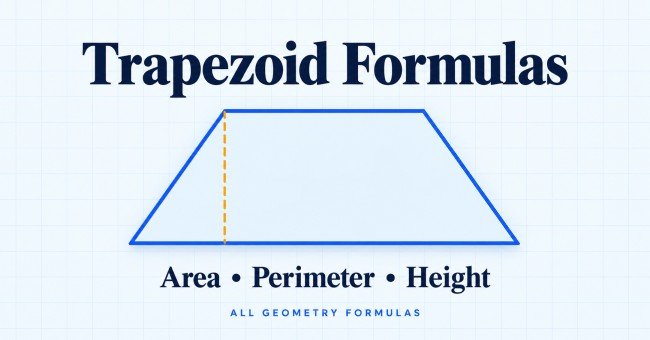
The main trapezoid formulas are area A = ½(b1 + b2)h and perimeter P = b1 + b2 + c + d. The parallel sides b1 and b2 are the bases, c and d are the other sides, and h is the perpendicular height.
In UK school maths, this shape is usually called a trapezium. This guide uses the common school definition of a trapezoid with exactly one pair of parallel sides. Some textbooks use a broader definition that includes parallelograms. The area formula works under either convention.
Trapezoid formulas at a glance
| What to find | Formula | What you need |
|---|---|---|
| Area | A = ½(b1 + b2)h | Both parallel bases and height |
| Perimeter | P = b1 + b2 + c + d | All four side lengths |
| Height | h = 2A/(b1 + b2) | Area and both bases |
| Missing base | b2 = 2A/h − b1 | Area, height and the other base |
| Midsegment | m = (b1 + b2)/2 | Both base lengths |
| Area using the midsegment | A = mh | Midsegment and height |
Symbols: A = area, P = perimeter, h = perpendicular height and m = midsegment. Subscripts 1 and 2 simply distinguish the two bases. Either base can be labelled b1; it does not have to be the longer one.
Read the bases and height correctly
The bases are the parallel sides, wherever they appear in the drawing. They might be horizontal, vertical or slanted. The height measures the shortest distance between their parallel lines. It always meets those lines at 90°.
The other two sides are called the legs. A sloping leg is not the height. In a right trapezoid, one leg is perpendicular to both bases, so that particular leg does equal the height. The bases do not need to sit directly above one another for the area formula to work.
Area of a trapezoid
Add the two base lengths, divide the sum by two, then multiply by the perpendicular height. In words, area = average of the bases × height. The answer uses square units such as cm2 or m2.
To see why this works, draw a diagonal across the trapezoid. It creates two triangles with bases b1 and b2. Both have height h. Their combined area is ½b1h + ½b2h, which factors into ½(b1 + b2)h.
Example 1: calculate the area
The parallel bases are 12 cm and 8 cm, and the height is 5 cm. First find the average base length: (12 + 8)/2 = 10 cm. Then multiply by the height:
A = ½(12 + 8) × 5 = 50 cm2. The sloping leg lengths are not needed for this calculation.
Perimeter of a trapezoid
Perimeter measures the distance around the outside. Add all four boundary edges: P = b1 + b2 + c + d. Do not add the height unless it is also one of those edges. Perimeter uses length units, not square units.
Example 2: add the four sides
A trapezoid has parallel bases of 17 cm and 9 cm, with both legs measuring 5 cm. Its perimeter is P = 17 + 9 + 5 + 5 = 36 cm. The legs are equal in this example, but they do not have to be equal in every trapezoid.
Find a missing height or base
When area is known, rearrange the area formula. Multiply the area by two before dividing or subtracting. Keep the brackets around the sum of the bases when you calculate height.
Example 3: find the height
The area is 126 m2, and the bases are 18 m and 10 m. Therefore, h = 2A/(b1 + b2) = 252/28 = 9 m. Checking gives ½ × 28 × 9 = 126 m2.
Example 4: find the unknown base
The area is 90 cm2, the height is 6 cm and one base is 20 cm. The sum of the bases is 2A/h = 180/6 = 30 cm. Subtract the known base: b2 = 30 − 20 = 10 cm. A zero or negative result would mean the measurements do not describe a valid trapezoid.
Midsegment formula
The midsegment, also called the median, joins the midpoints of the two legs. It is parallel to the bases, and its length is their average: m = (b1 + b2)/2. This gives another way to write the area formula: A = mh.
Example 5: use the midsegment
For bases of 18 cm and 10 cm, the midsegment is m = 28/2 = 14 cm. If the height is 6 cm, the area is A = 14 × 6 = 84 cm2. The midsegment is inside the shape, so it is not added to the perimeter.
Isosceles trapezoid formulas
An isosceles trapezoid has equal legs. If each leg has length s, its perimeter is P = b1 + b2 + 2s. Its equal base angles place the shorter base centrally above the longer one.
Drop perpendicular heights from the ends of the shorter base. The difference between the bases splits equally between two right triangles. Each horizontal offset is x = |b1 − b2|/2, so h = √(s2 − x2). The leg must be longer than x for the height to be positive.
Example 6: find height, area and perimeter
The bases are 14 cm and 8 cm, and each leg is 5 cm. The horizontal offset is (14 − 8)/2 = 3 cm. Use Pythagoras:
- Height: h = √(52 − 32) = √16 = 4 cm.
- Area: A = ½(14 + 8) × 4 = 44 cm2.
- Perimeter: P = 14 + 8 + 5 + 5 = 32 cm.
The two diagonals of an isosceles trapezoid are equal. Each has length D = √(b1b2 + s2). In this example, D = √(112 + 25) = √137 cm ≈ 11.70 cm. This diagonal formula requires equal legs; do not use it for an arbitrary trapezoid.
Right trapezoid formulas
A right trapezoid has two right angles. Its perpendicular leg is h. The other leg is the hypotenuse of a right triangle with horizontal length |b1 − b2| and vertical length h. Its length is √[(b1 − b2)2 + h2].
Example 7: find the sloping leg
The bases are 16 cm and 8 cm, and the perpendicular leg is 6 cm. The sloping leg is √(82 + 62) = 10 cm. The perimeter is 16 + 8 + 6 + 10 = 40 cm, and the area is ½ × 24 × 6 = 72 cm2.
Common mistakes to avoid
- Using the two legs instead of the two parallel bases in the area formula.
- Treating a sloping side as the perpendicular height.
- Forgetting the factor of ½, or dividing only one base by two.
- Using an isosceles formula when the legs are unequal.
- Mixing units. Convert all lengths to the same unit before calculating.
Try these practice questions
- The bases are 16 cm and 10 cm, and the height is 4 cm. Find the area.
- The area is 84 m2, and the bases are 15 m and 9 m. Find the height.
- An isosceles trapezoid has bases 18 cm and 10 cm, with legs of 5 cm. Find its height, area and perimeter.
Answers: 1) A = 52 cm2. 2) h = 7 m. 3) Offset = 4 cm, h = 3 cm, A = 42 cm2 and P = 38 cm.
Frequently asked questions
Are trapezoid and trapezium the same shape?
The shape called a trapezoid in US maths is usually called a trapezium in UK maths. Check the definition used by your textbook, since naming conventions differ.
Can I calculate area from the bases alone?
No. The bases do not determine the height. You need the perpendicular height or enough extra information to calculate it, such as equal leg lengths in an isosceles trapezoid.
When is a leg also the height?
In a right trapezoid, the leg perpendicular to the parallel bases equals the height. A sloping leg does not.
Are the diagonals always equal?
No. They are equal in an isosceles trapezoid, but a general trapezoid can have diagonals of different lengths.
Does a trapezoid have volume?
A trapezoid is two-dimensional, so it has area and perimeter. A prism with trapezoidal bases has volume equal to the trapezoid’s area multiplied by the perpendicular distance between the two bases.
Compare with the parallelogram formulas, triangle formulas and rectangle formulas, or browse all 2D Formulas guides.
Reference texts: OpenStax, Prealgebra 2e, Appendix C, and Contemporary Mathematics, section 10.6; Wolfram MathWorld, Trapezoid and Isosceles Trapezoid. Numerical examples and practice questions were written for this guide.
